
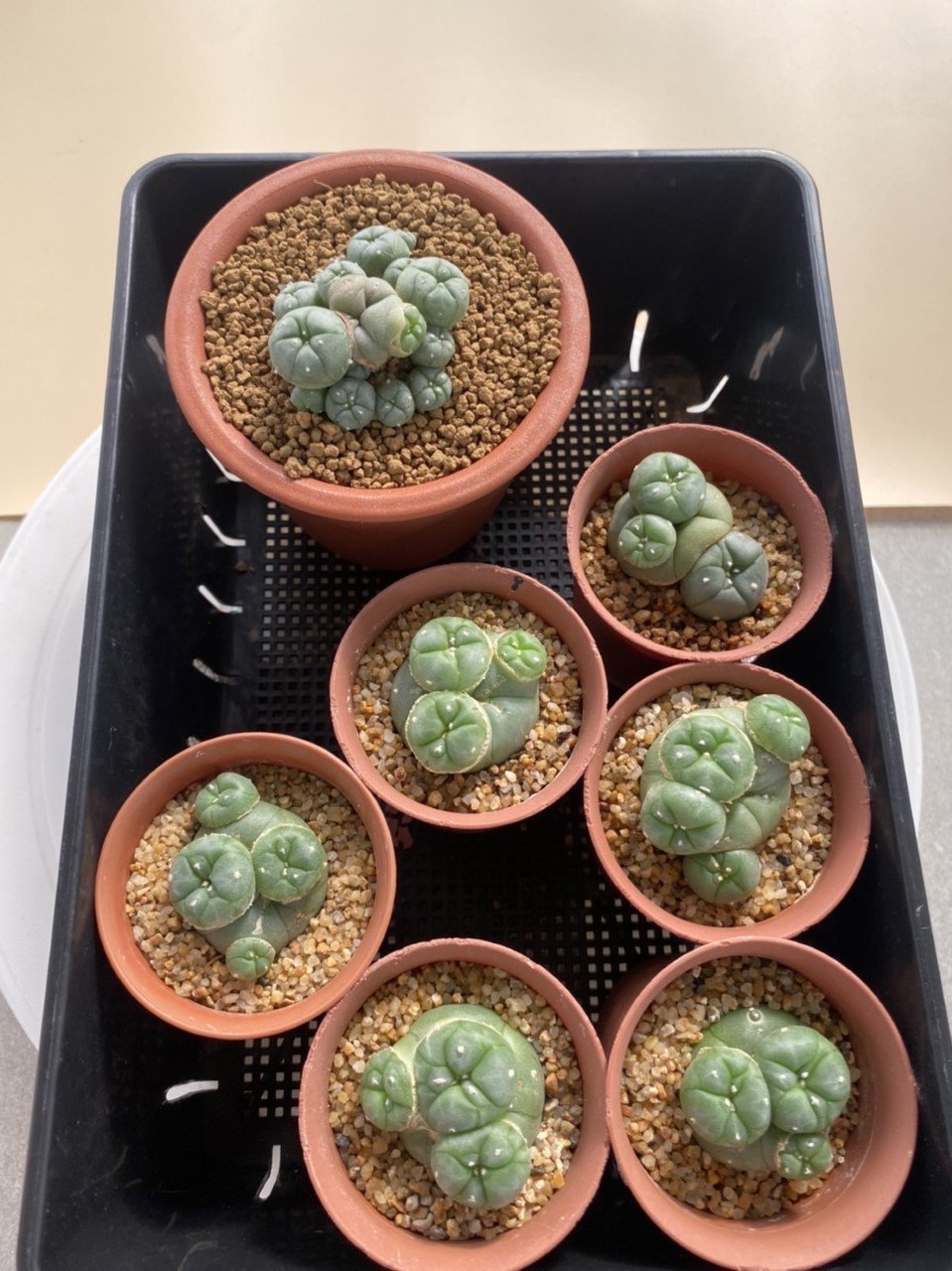
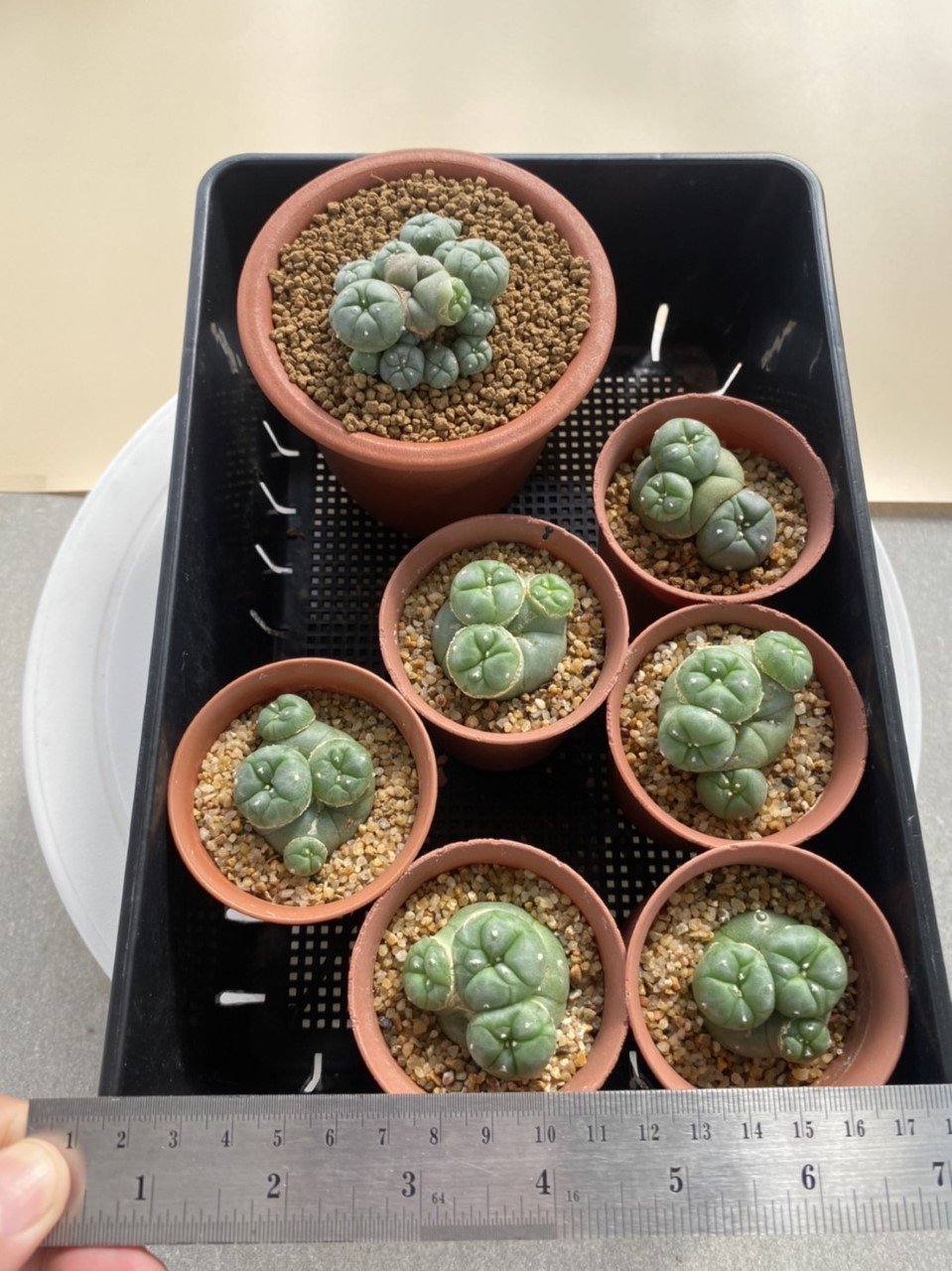
Description
Lophophora williamsii Montrose: The Rare Irregular Peyote Cactus — History, Symbolism, and Cultivation
Meta Description
Discover the rare Lophophora williamsii montrose, an 8-year-old, seed-grown, own-root cactus known for its unusual sculptural growth and cultural heritage. Learn about its history, morphology, symbolism, and expert cultivation.
Introduction: The Irregular Beauty of the Montrose Peyote
Among the rarest and most visually fascinating members of the Lophophora genus, the Montrose form of Lophophora williamsii stands as a remarkable example of nature’s creative expression. Unlike the classic round, button-shaped Peyote, the Montrose Peyote grows in unpredictable, irregular forms, a living sculpture shaped by chance and time.
This 8-year-old, seed-grown, own-root, flowering specimen is a true collector’s treasure. Its sculptural ridges, undulating forms, and organic patterns make it appear almost hand-carved by the desert itself. To botanists, it represents a unique case of fasciated growth; to collectors, it is living art; and to cultural historians, it remains a symbol of natural reverence and patience.
In this guide, we’ll explore everything about Lophophora williamsii montrose, from its genetic uniqueness and history to its horticultural care, cultural significance, and conservation importance.
What Is Lophophora williamsii Montrose?
Botanical Classification
-
Scientific name: Lophophora williamsii var. Montrose
-
Common name: Montrose Peyote cactus
-
Family: Cactaceae
-
Origin: Chihuahuan Desert (Northern Mexico and Southern Texas)
-
Growth habit: Irregular, multi-lobed, and often cresting
-
Average size: 3.5–4.5 cm in diameter at 8 years of age
-
Age of maturity: 7–10 years for flowering
-
Growth rate: Very slow (few millimeters per year)
-
Flower color: Pale pink to white
The Montrose form represents a genetic deviation from the typical Lophophora williamsii structure. Instead of producing a single symmetrical stem, it forms multiple distorted lobes or clusters, creating intricate and unpredictable shapes.
Each Montrose Peyote is completely unique, no two plants are identical, making them among the most collectible and conversation-worthy species in the cactus world.
The Mystery of Montrose Growth: Natural Mutation in Motion
The term Montrose refers to a growth mutation where a cactus grows in irregular, sometimes crest-like forms. In botanical terms, this phenomenon arises due to abnormal cell division in the meristem (growth point).
How Montrose Growth Happens
In a normal Peyote, the meristem produces new cells evenly, leading to a round, symmetrical button shape. In the Montrose form, however, cell division occurs unevenly, causing bizarre and unpredictable growth patterns — bumps, lobes, and fans that intertwine organically.
This variation, while rare, can occur naturally in the wild or through careful cultivation. Once established, the Montrose form remains genetically stable, continuing its irregular pattern for life.
Aesthetic and Scientific Appeal
To scientists, the Montrose Peyote is an example of plant developmental plasticity, how living organisms express genetic diversity through physical form.
To collectors, it is the embodiment of natural art, an unpredictable masterpiece created by biology and time.
A Living Sculpture: The Visual Appeal of Montrose Peyote
Every Montrose Peyote displays its own geometry, clusters of rounded segments arranged in seemingly random order. Its surface may appear as a series of sculpted mounds, folds, or waves, forming an abstract living sculpture that captivates the eye.
Because of its irregular form, each specimen seems to tell a different story, a desert rhythm of chaos and beauty, shaped by sunlight, soil, and slow growth.
Why Collectors Cherish It
-
Uniqueness: No two Montrose Peyotes share the same pattern.
-
Age and patience: Reaching maturity requires years of care.
-
Texture and symmetry: The tactile quality makes it visually and physically engaging.
-
Cultural depth: Represents resilience and adaptation in desert life.
For serious collectors, an 8-year-old, seed-grown Montrose Peyote combines rarity, authenticity, and aesthetics, the pinnacle of living cactus art.
Historical and Cultural Context
Origins of Reverence
The genus Lophophora has been known and respected by Indigenous peoples of northern Mexico and the American Southwest for millennia. In traditional worldviews, Peyote symbolizes endurance, harmony, and the link between humanity and nature.
Although the Montrose form itself is a horticultural rarity, its lineage ties it to the same ancestral species that inspired centuries of artistic, medicinal, and ceremonial traditions.
Cultural Symbolism
In many Indigenous cosmologies, the cactus embodies transformation, surviving in harsh conditions through adaptation and patience. The Montrose Peyote’s irregular, ever-changing form perfectly mirrors this symbolism, representing the unpredictable yet harmonious forces of life.
Its sculptural growth reminds us that beauty often lies in imperfection, a reflection of nature’s creative resilience.
Age and Authenticity: Why an 8-Year-Old Montrose Matters
An 8-year-old, flowering, seed-grown Montrose Peyote reflects the essence of ethical cultivation and long-term care.
While grafted Peyotes grow faster, they often lack the durability and authentic shape of own-root plants. A seed-grown, own-root cactus develops slowly, forming its natural taproot and growing in rhythm with its environment, just as it would in the wild.
Each passing year strengthens its structure, deepens its coloration, and enhances its collector’s value.
Indicators of Authentic Maturity
-
Stable form: Irregular, sculpted body with balanced lobes.
-
Root structure: Deep, strong taproot indicating long-term health.
-
Flowering stage: Sign of biological readiness and resilience.
-
Age: A full eight years of patient cultivation.
Such plants are considered benchmark specimens in botanical collections and ethnobotanical studies.
The Flowering Stage: Symbolism and Growth
Flowering marks one of the most significant milestones in the life of any Peyote cactus. When Lophophora williamsii montrose reaches maturity, it produces delicate pinkish-white blooms that contrast beautifully against its textured body.
Symbolic Meaning of Flowering
-
Renewal: The plant’s ability to reproduce and continue its lineage.
-
Harmony: The coexistence of irregular form and perfect bloom.
-
Fulfillment: The reward of years of careful tending and observation.
For collectors, a flowering Montrose Peyote is not only a sign of success but also a living symbol of growth and gratitude.
How to Grow and Care for Lophophora williamsii Montrose
Despite its rarity, the Montrose Peyote is surprisingly robust and adaptable when given the right environment.
Soil Composition
Use a mineral-based cactus mix with added pumice, perlite, or coarse sand. Avoid organic-rich soils that retain moisture.
Watering Routine
Water sparingly and allow the substrate to dry completely before watering again. Overwatering is the main cause of root problems.
Lighting
Provide bright, indirect light. The Montrose form prefers gentle exposure, as its irregular ridges can make some areas more prone to sunburn.
Temperature
Maintain between 18°C and 30°C (65°F–86°F). Protect from frost and excess humidity.
Fertilization
Feed once monthly during the growing season (spring–summer) with a diluted, low-nitrogen cactus fertilizer. Stop feeding during dormancy.
Potting and Drainage
Choose a shallow pot with drainage holes. Repot every few years to refresh soil and examine root health.
With attentive but minimalist care, Lophophora williamsii montrose can live for many decades, growing slowly but steadily into an extraordinary, mature specimen.
Seed-Grown and Own-Root: The Gold Standard
Collectors and horticulturalists value seed-grown, own-root Montrose Peyote as the most authentic expression of the plant.
Unlike grafted versions, which depend on a different cactus base, own-root plants are self-sustaining and develop their natural structure.
Benefits of Seed-Grown, Own-Root Plants
-
Authentic physiology — mimics natural desert development.
-
Resilient longevity — grows in rhythm with its environment.
-
Ethical cultivation — no harvesting from wild populations.
-
True-to-form growth — displays genuine Montrose morphology.
Each seed-grown Montrose Peyote is both a scientific curiosity and a living legacy of sustainable cultivation.
Ethical Cultivation and Conservation
Protecting Wild Populations
Wild Lophophora species face pressures from habitat loss and illegal harvesting. Ethical growers and collectors play a key role in conservation by cultivating from seed rather than collecting from the wild.
Sustainable Practices
-
Support nurseries and growers who use seed propagation.
-
Educate others about ethical collecting and biodiversity protection.
-
Share cultivated specimens to reduce wild demand.
Educational Importance
Cultivated Montrose Peyotes serve as excellent teaching specimens in botanical gardens, conservation programs, and cultural education, highlighting the intersection of science, spirituality, and sustainability.
Peyote Montrose in Botanical and Cultural Education
In academic and educational contexts, Lophophora williamsii montrose offers insight into multiple disciplines:
-
Botany: Understanding fasciation and irregular growth.
-
Genetics: Studying natural mutations and plant adaptability.
-
Ethnobotany: Exploring human–plant relationships through time.
-
Aesthetics: Appreciating natural design and organic geometry.
By studying and cultivating this species, we continue the human legacy of curiosity, respect, and wonder toward the plant kingdom.
Why This Montrose Peyote Is Special
This 8-year-old, seed-grown, own-root, flowering Montrose Peyote is extraordinary because it combines:
Rarity – an uncommon growth form within an already rare species.
Maturity – capable of flowering and producing seeds.
Authenticity – seed-grown on its own root for natural development.
Symbolism – a reminder of resilience and imperfection’s beauty.
Conservation value – cultivated ethically, preserving wild biodiversity.
To own or study such a specimen is to connect with both ancient desert heritage and modern conservation efforts.
Conclusion: Harmony in Irregularity
The Lophophora williamsii montrose challenges our understanding of symmetry, growth, and perfection. In its irregular forms, we see the beauty of variation and the endless creativity of nature.
Over eight patient years, this seed-grown cactus has matured into a symbol of resilience, a living artwork that unites science, spirituality, and care.
To cultivate or study the Montrose Peyote is to witness the poetry of the desert itself: silent, slow, and infinitely intricate. It reminds us that in nature, even irregularity has purpose, and in patience, there is timeless beauty.
![Peyote [Lophophora Williamsii] 7-8 cm 18 years old seed ownroot flower seedling](https://mr-cactuspeyote.us/wp-content/uploads/2025/10/IMG_6095-1-300x300.jpeg)

