
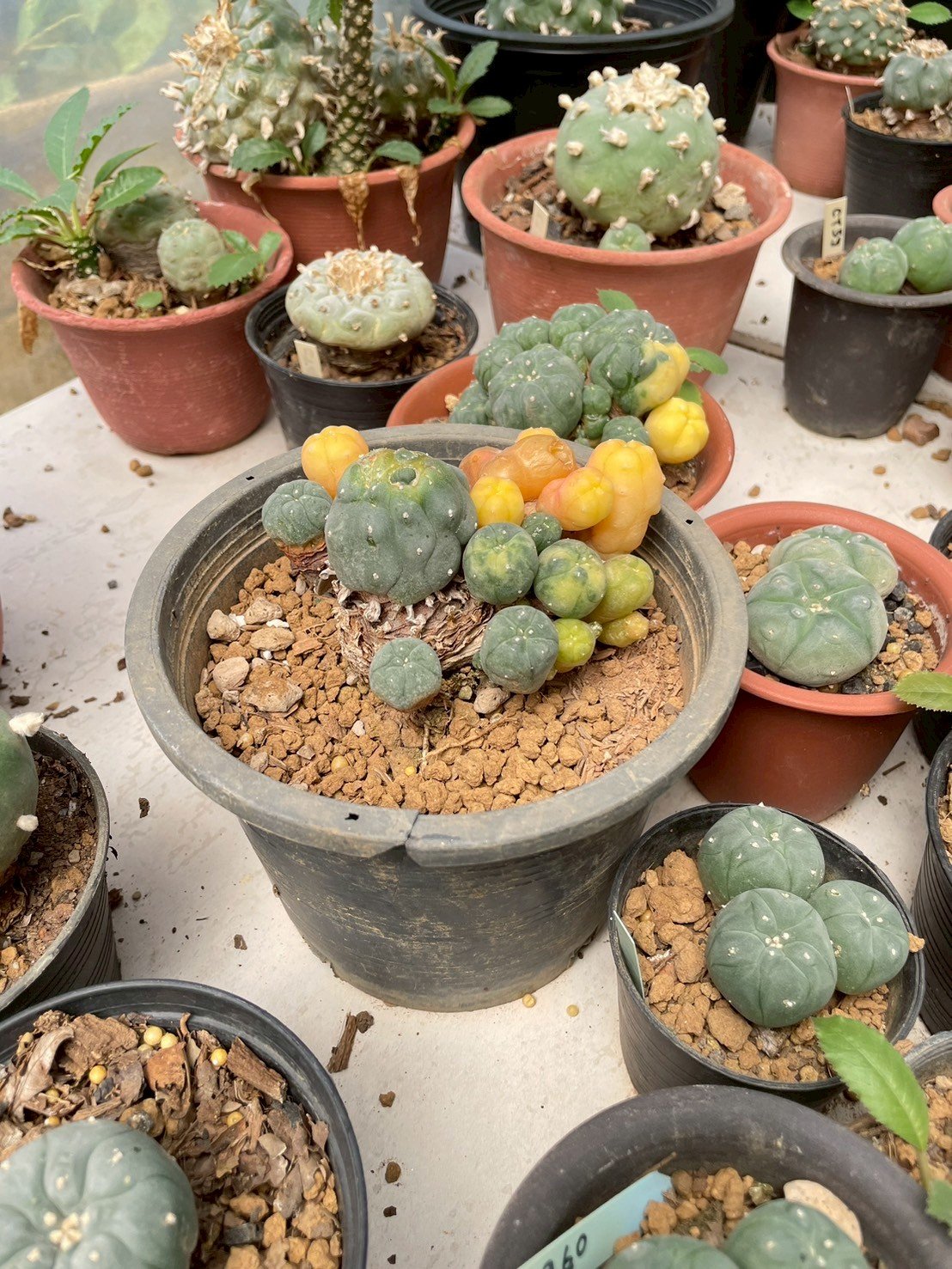
Description
Lophophora williamsii Variegata: The Variegated Peyote Cactus — History, Beauty, and Cultivation
Meta Description
Explore the rare Lophophora williamsii variegata, a beautifully marbled, seed-grown cactus revered for its artistry and cultural heritage. Learn about its unique coloration, symbolism, and expert cultivation techniques.
Introduction: Nature’s Marbled Masterpiece
The Lophophora williamsii variegata, or Variegated Peyote cactus, is one of nature’s most visually enchanting creations, a living work of art combining the sacred symbolism of Lophophora with the mesmerizing hues of variegation. Measuring 6–7 cm in diameter and cultivated from seed over 12 years, this flowering, own-root specimen represents the perfect fusion of botanical rarity, cultural depth, and natural elegance.
Admired by collectors, ethnobotanists, and spiritual gardeners worldwide, the variegated Peyote is a cactus that captures both scientific fascination and aesthetic wonder. Each plant’s marbled surface tells a story of patience, adaptation, and the quiet genius of evolution, a story still unfolding after thousands of years.
What Is Lophophora williamsii Variegata?
Botanical Identity
-
Scientific Name: Lophophora williamsii var. Variegata
-
Common Name: Variegated Peyote
-
Family: Cactaceae
-
Native Range: Chihuahuan Desert, Northern Mexico & southern Texas
-
Growth Habit: Globular, spineless, and slow-growing
-
Diameter (mature): 6–8 cm
-
Age at flowering maturity: ~10–15 years
-
Distinctive Feature: Irregular patterns of green, yellow, and cream coloration
The Variegata form of Lophophora williamsii is a naturally occurring genetic variation that affects the chlorophyll distribution in its tissues. This irregular pigmentation produces the cactus’s striking marbled patterns, blending tones of green, gold, and ivory in organic harmony.
Each specimen develops a unique variegation pattern, ensuring no two plants are ever identical. This individuality, combined with the plant’s sacred ancestry, makes Lophophora williamsii variegata one of the most collectible and symbolically significant cacti in existence.
The Art of Variegation: A Natural Phenomenon
Understanding Variegation
Variegation refers to the appearance of differently colored zones on a plant’s surface, usually resulting from mutations in the chlorophyll-producing cells. In cacti, this occurs when certain cells lose chlorophyll, creating pale yellow or cream-colored areas that contrast with the green.
In Lophophora williamsii variegata, this results in breathtaking swirls, streaks, and marbled mosaics that resemble brushstrokes of living paint.
Why Collectors Value Variegation
-
Visual uniqueness: Every cactus exhibits a one-of-a-kind pattern.
-
Rarity: True variegation in Lophophora species is uncommon and often unpredictable.
-
Challenge of cultivation: Variegated plants grow slower, requiring extra care and stability.
-
Symbolism: Represents balance between light and shadow, life and transformation.
A mature, flowering, seed-grown Lophophora williamsii variegata therefore symbolizes both rarity and perseverance, qualities deeply admired by collectors and horticulturalists.
Historical and Cultural Significance of Peyote
Ancient Origins
For over 5,000 years, Lophophora williamsii has played an important role in the cultural and spiritual traditions of Indigenous peoples of Mexico and the American Southwest. Archaeological findings and ancient artworks indicate its use in ceremonial, artistic, and medicinal contexts long before recorded history.
In these traditions, Peyote was regarded as a sacred messenger plant, representing communication between humanity and the natural or spiritual world. It was often linked with renewal, harmony, and the cycles of nature, values still celebrated by many cultural groups today.
Symbolism of the Variegated Form
While the traditional, non-variegated Peyote is historically recognized, the Variegata variety embodies new layers of meaning in contemporary ethnobotanical culture. Its multi-colored patterns are often interpreted as symbols of:
-
Unity in diversity — light and dark coexisting in balance.
-
Transformation — nature’s way of expressing beauty through variation.
-
Resilience — adaptation and strength in challenging environments.
-
Harmony — reflecting equilibrium between earth, sun, and spirit.
Modern collectors appreciate Lophophora williamsii variegata not only as a botanical rarity but also as a metaphor for creative balance and evolutionary beauty.
A Testament to Time: The 12-Year Journey
This particular specimen, 12 years old and flowering, exemplifies the slow, deliberate rhythm of desert life. Cultivated from seed and grown on its own roots, it represents an unbroken connection between natural lineage and careful human stewardship.
Unlike grafted plants, which are accelerated artificially, seed-grown, own-root Peyote develops in harmony with its environment, forming natural taproots and authentic structures identical to wild populations.
Each year of growth adds depth, resilience, and authenticity, making this cactus a living testament to patience and time, an ideal educational specimen for anyone studying plant morphology, adaptation, or cultural botany.
Flowering: The Crown of Maturity
The Beauty of Peyote Blooms
When Lophophora williamsii variegata reaches maturity, it produces delicate pinkish-white flowers that bloom from the crown’s woolly center. These blossoms typically appear during warm months and open under bright light.
Symbolism of Flowering
-
Biological maturity: Confirms health and full development.
-
Aesthetic grace: Contrasts the smooth body with soft floral hues.
-
Continuity: Marks the plant’s readiness to reproduce and sustain its lineage.
In botanical and cultural symbolism alike, flowering represents balance, fulfillment, and renewal, a fitting theme for a plant so deeply tied to cycles of time and transformation.
Seed-Grown, Own-Root Cultivation: Why It Matters
In the world of cactus cultivation, seed-grown, own-root plants are considered the gold standard of authenticity. While grafting can accelerate growth, it often compromises the plant’s natural form and lifespan.
Benefits of Own-Root Peyote
-
Authentic growth patterns — mirrors wild-type physiology.
-
Stronger resilience — develops its own taproot for water storage.
-
Longer lifespan — stable, sustainable growth.
-
Aesthetic integrity — retains the true shape of Lophophora williamsii.
-
Educational value — ideal for scientific and conservation studies.
This 12-year-old, flowering, seed-grown Variegata Peyote perfectly demonstrates natural development and cultivation excellence.
Caring for Lophophora williamsii Variegata
Growing Lophophora williamsii variegata requires an understanding of its desert origins, minimal water, ample light, and well-drained soil.
Soil Composition
Use a mineral-based cactus substrate with added pumice, perlite, or coarse sand. Avoid rich, moisture-retaining organic soil.
Watering Routine
Water sparingly. Let the soil dry completely before watering again. Overwatering is the most common cause of root rot.
Light Exposure
Bright, indirect light is ideal. Too much direct midday sun may cause stress on variegated tissue. Filtered sunlight promotes balanced growth and preserves coloration.
Temperature Range
Keep within 18°C–30°C (65°F–86°F). Protect from frost and prolonged dampness.
Fertilization
Feed lightly during spring and summer with a low-nitrogen cactus fertilizer. Pause feeding during dormancy.
Container Selection
Use shallow pots with adequate drainage. Lophophora roots prefer lateral spread over depth.
Dormant Season
Reduce watering during winter and keep in a dry, well-ventilated area until active growth resumes in spring.
Conservation and Ethical Growing
Due to environmental pressures and unsustainable harvesting, wild Peyote populations have declined significantly in recent decades. Responsible, seed-based cultivation is therefore essential for protecting this species and preserving its cultural significance.
Ethical cultivation promotes:
-
Sustainability: Reducing wild collection through propagation.
-
Education: Teaching respect for native habitats and Indigenous traditions.
-
Biodiversity: Maintaining genetic variety through responsible breeding.
Collectors and growers who focus on conservation not only preserve a rare species but also honor centuries of ecological and cultural heritage.
The Role of Peyote Variegata in Botanical and Educational Contexts
Lophophora williamsii variegata offers valuable insight into genetics, evolution, and cultural symbolism. It is frequently studied and exhibited in botanical gardens and educational programs exploring:
-
Desert adaptation and morphology
-
Plant pigmentation and variegation genetics
-
Ethnobotanical traditions
-
Sustainable horticultural practices
By cultivating and studying this species, educators and students continue a long tradition of respectful stewardship and cross-cultural learning.
Why This 12-Year-Old Variegated Peyote Is Special
This 6–7 cm, 12-year-old, seed-grown, flowering specimen represents the essence of natural artistry and ethical cultivation.
Variegated beauty: Unique marbled patterns of green, yellow, and cream.
Flowering maturity: Proof of vitality and balance.
Own-root growth: Authentic and resilient.
Seed-grown heritage: Ethically cultivated and ecologically responsible.
Cultural resonance: A living reminder of humankind’s ancient respect for desert flora.
Owning or studying such a cactus is not merely an act of collecting, it is participating in a living continuum of art, science, and tradition.
Conclusion: Harmony in Color and Time
The Lophophora williamsii variegata is more than a cactus, it is a symbol of balance and transformation. Its marbled skin reflects both sunlight and shadow, just as nature itself reflects harmony through diversity.
After 12 years of slow, steady growth, this flowering, own-root Peyote stands as a tribute to endurance, artistry, and sacred ecology.
In caring for it, collectors and educators engage with an ancient lineage of respect, patience, and wonder, reminding us that beauty is not found in speed or perfection, but in the steady unfolding of life’s natural rhythm.
![Peyote [Lophophora Williamsii] 7-8 cm 18 years old seed ownroot flower seedling](https://mr-cactuspeyote.us/wp-content/uploads/2025/10/IMG_6093-300x300.jpeg)

![Peyote [Lophophora Williamsii] 3.5-4.5 cm 8 years old ownroot from seed flowering](https://mr-cactuspeyote.us/wp-content/uploads/2025/10/IMG_6090-300x300.jpeg)