
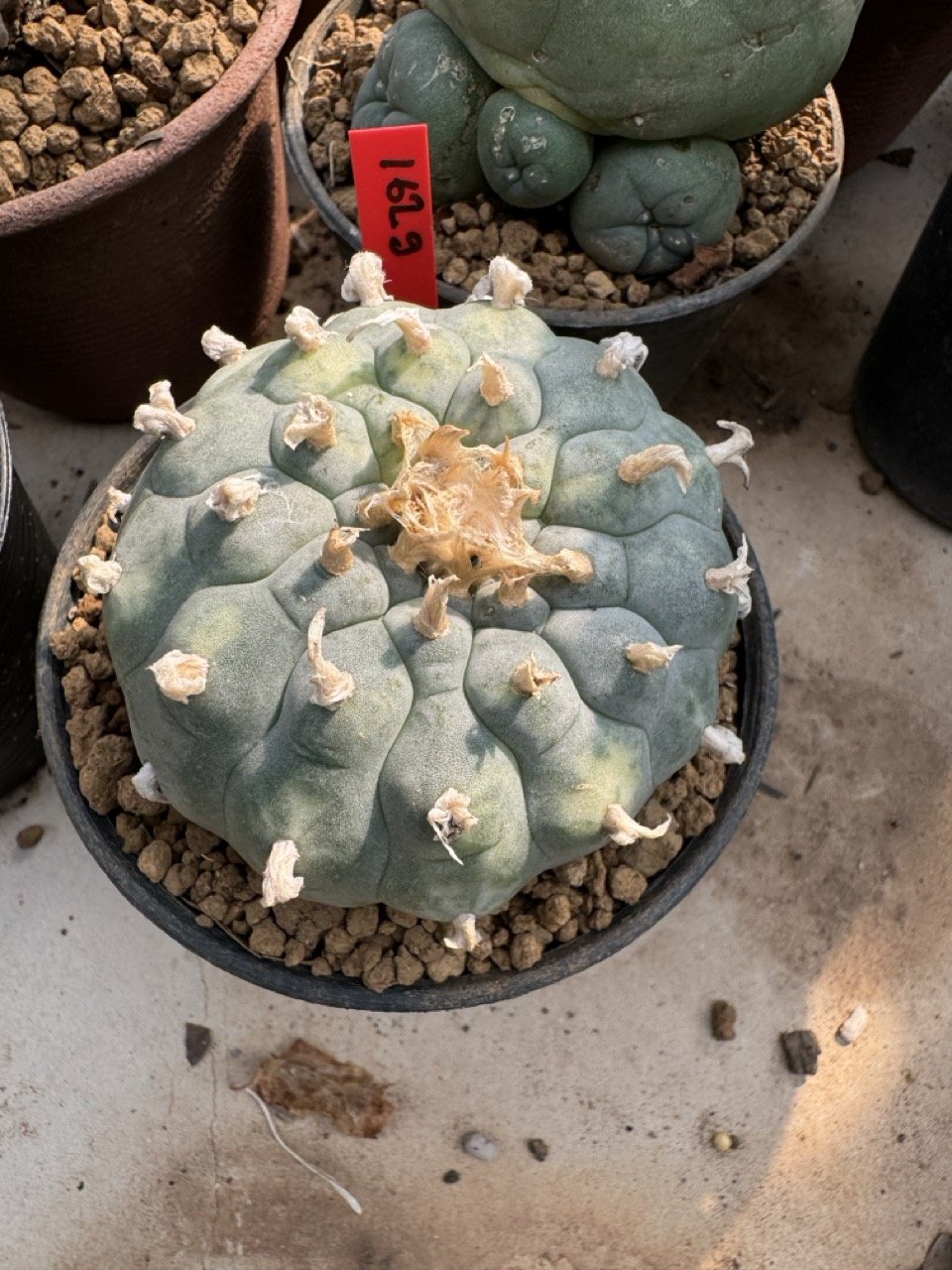


Description
Lophophora williamsii variegata: A 25-Year-Old Masterpiece of Nature’s Artistry
Meta Description
Discover the beauty and heritage of Lophophora williamsii variegata, a 25-year-old, seed-grown cactus admired for its striking marbled patterns, slow maturity, and cultural significance. Learn its history, care, and conservation importance in this educational guide.
Introduction: The Living Jewel of the Desert
Among all members of the Lophophora genus, few capture attention quite like the variegated Peyote (Lophophora williamsii variegata).
This 7–8 cm, 25-year-old specimen, grown patiently from seed on its own roots, represents a rare blend of endurance, natural mutation, and aesthetic brilliance.
Its intricate marbling of green, yellow, and cream transforms this cactus into a living piece of art, celebrated by collectors, educators, and ethnobotanical researchers alike. Beyond its visual allure, it embodies a story of patience, adaptation, and reverence for nature.
Botanical Overview
| Scientific Classification | Details |
|---|---|
| Scientific Name | Lophophora williamsii variegata |
| Common Names | Variegated Peyote, Variegated Lophophora |
| Family | Cactaceae |
| Native Habitat | Chihuahuan Desert (Northern Mexico and Southern Texas) |
| Growth Form | Globular, spineless, low-growing |
| Distinctive Feature | Variegated pigmentation (green–yellow–cream marbling) |
| Mature Size | 7–8 cm diameter |
| Flower Color | Soft pink to white |
The variegata form of Lophophora williamsii is an exceptional natural variant distinguished by its uneven chlorophyll distribution. This genetic variation produces spectacular marbling across the epidermis, making each plant entirely one-of-a-kind.
Understanding Variegation: The Science Behind the Beauty
What Causes Variegation?
Variegation in plants occurs when chlorophyll (the green pigment used in photosynthesis) is distributed unevenly across the tissue. Areas with reduced chlorophyll appear yellow or cream, contrasting against the green sections.
In Lophophora williamsii variegata, this phenomenon creates organic marbling patterns, often streaking or swirling across the body of the cactus.
Why It’s Rare
True variegation is genetically unpredictable. It can emerge spontaneously in seedlings or occasionally through natural mutation during growth. Because variegated sections photosynthesize less efficiently, these plants grow slower, making a 25-year-old specimen like this one extraordinarily rare.
Symbolism in Nature
Variegation symbolizes balance and harmony between light and life, a visual reminder of diversity within natural design. In botany education, it serves as a living case study of adaptation and genetic variation.
The Aesthetic and Artistic Value of Variegated Peyote
Collectors and horticultural artists prize Lophophora williamsii variegata not just for its rarity but for its visual poetry.
Key Aesthetic Features
-
Color Palette: Shades of mint, sage, yellow, and cream blend organically.
-
Texture: Soft, matte skin with woolly tufts in the areoles.
-
Form: Rounded and symmetrical, often forming clusters with age.
-
Flowers: Delicate pale pink blossoms that emerge seasonally, adding contrast to its marbled surface.
Each specimen becomes a natural sculpture, shaped by decades of slow, deliberate growth. Its serene, almost meditative appearance has made it a centerpiece in educational exhibits and botanical art collections around the world.
The Journey of a 25-Year-Old Seed-Grown Specimen
Reaching 25 years of age represents an exceptional achievement in cactus cultivation.
The Value of Seed-Grown Authenticity
Unlike grafted plants, which grow more quickly on other rootstocks, seed-grown, own-rooted Lophophora maintain their full natural form and resilience.
They develop slowly, mirroring their desert counterparts, and often live for many decades.
The Significance of Age
At 25 years old, this cactus has likely experienced hundreds of subtle environmental cycles, seasonal light variations, temperature shifts, and natural growth pauses.
Each ring and shade variation on its surface tells a story of endurance and ecological harmony.
Cultural and Historical Significance
Indigenous Context
For centuries, Lophophora species have held symbolic importance among Indigenous communities in Mexico and the American Southwest. Traditionally regarded as sacred desert plants, they represent balance, healing, and deep connection to the earth.
While modern collectors admire Lophophora williamsii variegata primarily for its botanical and aesthetic rarity, it remains intertwined with a long legacy of respect and cultural meaning.
Modern-Day Relevance
Today, the variegated Peyote is cherished globally for its ornamental beauty, conservation value, and scientific intrigue. Researchers and educators use it to teach lessons about biodiversity, slow growth, and sustainability.
It serves as a living reminder of how culture, science, and art intersect through nature.
Flowering and Reproduction
Flowering in mature Lophophora williamsii variegata specimens is a sign of exceptional health and stability.
Flower Characteristics
-
Appearance: Pale pink or white flowers about 1–2 cm across.
-
Season: Typically late spring through mid-summer.
-
Pollination: Capable of self-pollination but benefits from cross-pollination for stronger seed viability.
-
Seed Development: Produces tiny, glossy black seeds within a small fruit capsule.
Each flower reflects the cactus’s maturity and biological rhythm, a testament to decades of patient cultivation.
Cultivation and Care Guide
Soil Requirements
Use a well-draining cactus mix composed of pumice, coarse sand, and perlite. A small proportion of mineral-rich soil supports slow, steady growth. Avoid heavy organic matter.
Watering
Adopt a soak-and-dry routine: water thoroughly, then allow the soil to dry completely before the next watering. Overwatering is the most common cause of root damage.
Lighting
Provide bright but filtered sunlight to protect its delicate variegated skin. Too much direct light can fade yellow patches or cause sunburn, while too little can dull colors.
Temperature
Maintain a dry environment between 18–30°C (65–86°F). Protect from frost, as cold damage can harm the variegated tissue.
Feeding
Apply a balanced cactus fertilizer once monthly during active growth (spring to summer). Stop fertilizing in autumn and winter.
Potting
Shallow, wide pots are ideal for Peyote’s taproot system. Ensure excellent drainage to prevent waterlogging.
When treated with care, Lophophora williamsii variegata can continue thriving and flowering for generations.
Conservation and Ethical Cultivation
The increasing demand for Lophophora species in the collector’s market makes ethical sourcing and propagation essential.
Sustainable Practices
-
Grow from seed: Always prioritize seed-grown specimens to reduce pressure on wild populations.
-
Avoid wild collection: Removing plants from native habitats endangers species survival.
-
Educate others: Share knowledge about ethical cultivation and conservation.
-
Participate in propagation: Collect and sow seeds responsibly to expand sustainable populations.
By promoting ethical cultivation, collectors contribute to biodiversity preservation and the cultural continuity of these plants.
The Symbolism of Variegation
The mesmerizing marbling of Lophophora williamsii variegata is more than a botanical anomaly, it symbolizes unity within diversity.
Symbolic Meanings
-
Balance: The harmony of green and yellow tones mirrors the equilibrium of light and shadow.
-
Resilience: Variegated plants grow slower but survive through balance and adaptation.
-
Uniqueness: No two are alike, each tells its own evolutionary story.
-
Time: The patient artistry of decades, revealed in organic design.
In horticultural philosophy, variegated plants remind us that beauty often arises from imperfection, a lesson deeply tied to nature’s creativity.
The Role of Lophophora williamsii variegata in Botanical Education
This rare cactus variety holds educational importance across several disciplines:
-
Botany and Morphology: Demonstrates the genetics of pigment expression and fasciation.
-
Ethnobotany: Serves as a cultural bridge for understanding traditional plant-human relationships.
-
Conservation Science: Highlights the challenges of protecting slow-growing desert flora.
-
Aesthetic Horticulture: Inspires artists and designers with natural geometry and texture.
For universities, research centers, and botanical gardens, Lophophora williamsii variegata functions as a living model of biodiversity and respect for ecological heritage.
Why This 25-Year-Old Specimen Stands Apart
Age & Authenticity: 25 years old, seed-grown, and own-rooted.
Unique Marbling: Every pattern distinct and naturally formed.
Flowering Maturity: Capable of producing seeds and continuing its lineage.
Ethical Cultivation: Grown sustainably from seed, not grafted or wild-harvested.
Educational Value: A model specimen for teaching and conservation.
Collector’s Appeal: Combines rarity, age, and natural artistry in one form.
This plant exemplifies how time, care, and nature’s unpredictability converge to produce something truly extraordinary.
Conclusion: A Testament to Time and Beauty
The Lophophora williamsii variegata stands as one of the desert’s most graceful creations, a plant that fuses science, art, and history.
At 25 years old, this specimen embodies the essence of endurance, patience, and quiet magnificence.
Its variegated skin tells the story of sunlight and shadow, growth and stillness, change and persistence.
Whether admired in a botanical garden, a collector’s greenhouse, or an educational exhibit, it remains a reminder of nature’s infinite capacity for artistry.


