
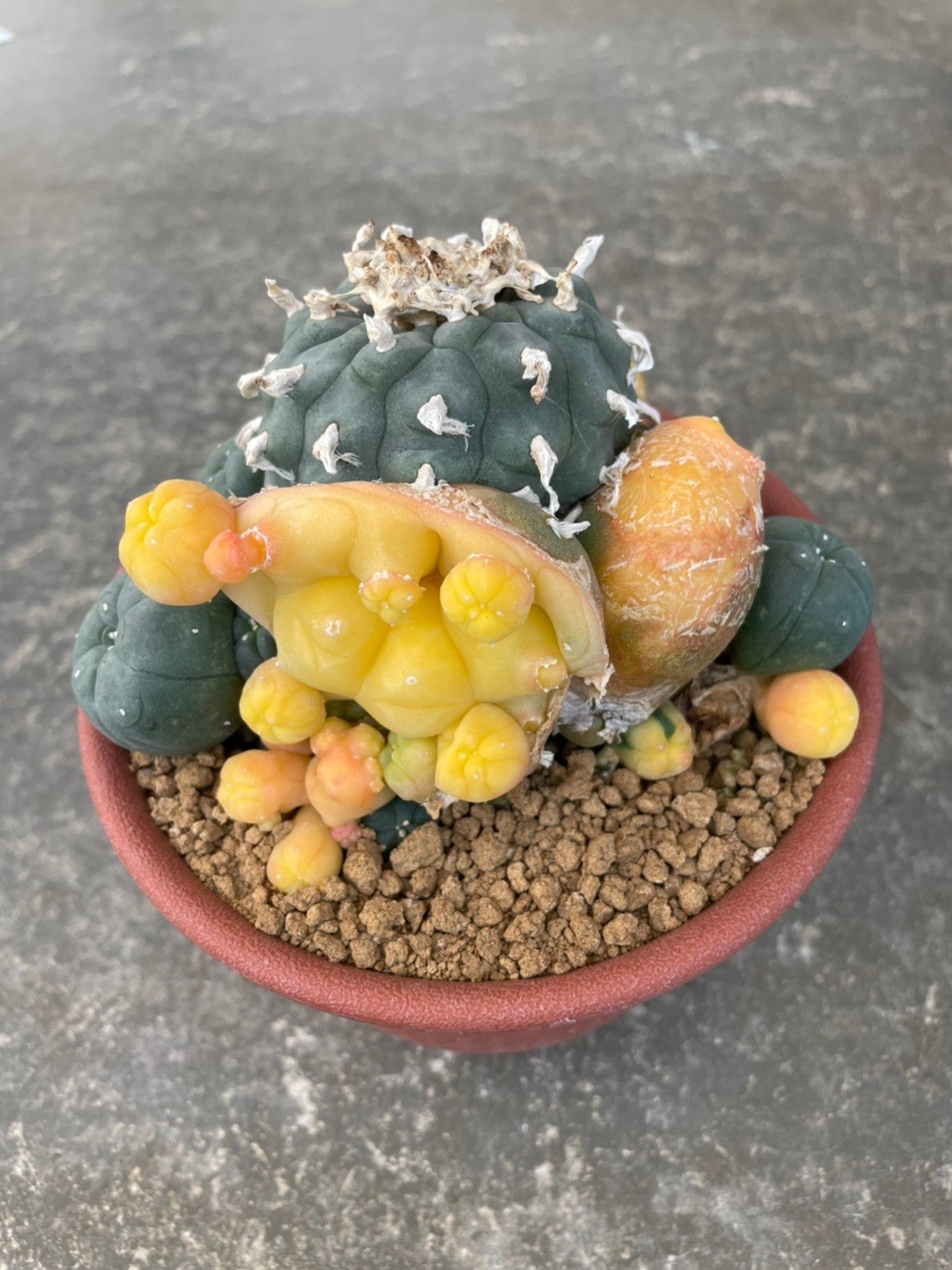

Description
Peyote (Lophophora williamsii Variegata) Buttons – 25 Years of Sacred Growth, Botanical Rarity, and Cultural Significance
Among the world’s most revered desert plants, Peyote (Lophophora williamsii Variegata) holds a special place in both botanical history and spiritual tradition. This extraordinary 25-year-old, seed-grown, own-root Peyote specimen represents one of the rarest and most visually captivating forms of the sacred cactus family.
Known for its slow and natural development, this variegated Peyote displays beautiful patterns of green, yellow, and cream tones, a feature that makes it one of the most sought-after variations among collectors and ethnobotanical enthusiasts. At a quarter-century old, it has reached full flowering and seed-producing maturity, carrying not only the visual grace of nature but also deep symbolic power.
What Are Peyote Buttons? Understanding Their Structure and Symbolism
Peyote buttons refer to the rounded, fleshy tops of the Lophophora williamsii cactus, the crown-like segments that store the plant’s essential compounds and energy. These buttons grow slowly, adding new layers each year like rings in a tree, making them living records of time, endurance, and the desert’s rhythm.
In traditional and spiritual contexts, Peyote buttons have been revered as symbols of wholeness, balance, and sacred connection. Their perfectly rounded form reflects cycles of nature, life, and rebirth. While historically used in indigenous ceremonies, today they are most often studied and appreciated for their botanical, cultural, and spiritual value rather than for ingestion.
Key Attributes of Peyote Buttons
-
Form: Rounded, spineless crown with ribs and tufts of wool at the areoles.
-
Growth: Adds small layers annually, forming distinctive rings with age.
-
Function: Produces flowers, fruit, and seeds at maturity.
-
Symbolism: Represents unity, continuity, and connection to the divine.
This 25-year-old Peyote (Variegata) specimen, with its mature buttons and flowering potential, is a remarkable representation of the plant’s life cycle and sacred beauty.
Variegata – A Rare and Stunning Form of Peyote
The Variegata form of Lophophora williamsii is exceptionally rare in cultivation. The word variegata refers to its multicolored appearance, in this case, a mesmerizing blend of green, yellow, and creamy tones caused by genetic variation that affects chlorophyll distribution.
Each button of the Peyote Variegata is unique, displaying artistic natural patterns that resemble marble or watercolor brushstrokes. This makes every plant one-of-a-kind, no two are ever identical.
Collectors prize the Variegata variety for both its rarity and its delicate growth requirements. Because variegated plants photosynthesize less efficiently, they grow even slower than typical Peyote, making a 25-year-old Variegata cactus extraordinarily special and valuable.
Lophophora williamsii Variegata – Botanical and Ecological Insight
Scientifically classified as part of the Cactaceae family, Lophophora williamsii Variegata thrives in the Chihuahuan Desert, where its wild relatives grow under the shelter of shrubs and limestone-rich soil.
Botanical Characteristics:
-
Genus: Lophophora
-
Species: williamsii
-
Variety: Variegata (variegated coloration)
-
Growth Habit: Low, button-like body without spines
-
Root System: Deep taproot storing water and nutrients
-
Flower: Pale pink to white, blooming at the crown
-
Habitat: Arid, rocky desert regions with minimal rainfall
The slow, rhythmic growth of Peyote symbolizes harmony with nature’s timing. Each mature button on this cactus is a testament to 25 years of adaptation and perseverance in the face of environmental challenge.
The Beauty of a 25-Year-Old Peyote (Variegata) Specimen
At 25 years old, this Peyote has reached the pinnacle of its natural growth cycle. Its smooth, rounded buttons form a perfectly symmetrical arrangement, each crowned with fine wool and vibrant coloration. When in bloom, soft pink flowers emerge from its crown, a sign of full maturity and vitality.
The ability to produce seeds adds immense value, allowing this specimen to contribute to the continuity of the Lophophora lineage. For educators, botanists, and collectors, this cactus serves as a living example of patience, beauty, and sacred connection.
Why This Peyote Variegata Is So Rare and Valuable
Owning a 25-year-old seed-grown Peyote (Lophophora williamsii Variegata) is an exceptional privilege. Several factors contribute to its uniqueness and value:
-
Age and Patience: Growing Peyote naturally takes decades. Reaching 25 years means this plant has developed fully over time without human interference or grafting.
-
Seed-Grown Authenticity: Unlike grafted Peyotes, seed-grown specimens have complete root systems, making them stronger and closer to their wild counterparts.
-
Own-Root Development: Growing on its own root ensures purity, resilience, and the plant’s ability to self-sustain.
-
Variegated Beauty: The mesmerizing color patterns make it both a scientific curiosity and a visual masterpiece.
-
Flowering and Seed-Producing: Its ability to bloom and propagate ensures the preservation of its sacred genetic line.
Such qualities make this Peyote not merely a cactus but a symbolic and cultural treasure. It is a living representation of natural time, devotion, and ancestral reverence.
Spiritual and Cultural Significance of Peyote
For countless generations, indigenous peoples of North and Central America have regarded Peyote as a holy plant, a sacred teacher that connects human consciousness with the divine. The Huichol, Tarahumara, and Native American Church communities hold ceremonial traditions involving Peyote as an expression of gratitude, healing, and unity.
Even outside ceremonial use, Peyote serves as a spiritual symbol, representing inner growth, clarity, and resilience. Its slow, steady development mirrors the human journey toward wisdom and self-understanding.
To possess a mature Peyote ethically cultivated in modern times is to honor that ancient lineage, a way to preserve and appreciate the cultural wisdom and sacred relationship between people and plants.
Educational Importance – Peyote in Conservation and Research
With wild Peyote populations declining due to overharvesting and habitat destruction, cultivated Peyotes like this 25-year-old specimen play an essential role in education and conservation.
Botanical gardens, universities, and ethnobotanical researchers study cultivated specimens to understand plant adaptation, desert ecology, and cultural ethnobotany. By encouraging seed-grown, legally cultivated Peyote, we can help preserve both biodiversity and indigenous cultural respect.
This aligns with global conservation ethics and the CITES Appendix II protection framework, which seeks to regulate trade and promote sustainable propagation.
Product Overview – Peyote (Lophophora williamsii Variegata) Buttons
| Attribute | Description |
|---|---|
| Botanical Name | Lophophora williamsii Variegata |
| Age | 25 years |
| Growth Type | Seed-grown, own-root (not grafted) |
| Flowering | Mature, flowering-capable |
| Seed Production | Capable of producing seeds |
| Coloration | Green, yellow, and cream variegation |
| Form | Rounded buttons with woolly areoles |
| Rarity | Extremely rare, collector-grade |
| Use | Educational, cultural preservation, ornamental display |
| Value | High – due to age, form, coloration, and authenticity |
How to Care for Peyote (Educational Overview)
For educational cultivation or botanical display, Peyote thrives under specific desert-like conditions:
-
Light: Bright but indirect sunlight; avoid excessive UV exposure.
-
Soil: Mineral-based, well-draining cactus mix with limestone or pumice.
-
Water: Minimal — water sparingly only when soil is completely dry.
-
Temperature: Prefers warmth (24–30°C) with cooler nights.
-
Humidity: Low humidity; prefers dry air.
-
Potting: Deep container to support its long taproot system.
Proper care ensures longevity, encourages flowering, and maintains the cactus’s natural color patterns.
The Symbolism of Age and Sacred Growth
In spiritual symbolism, older Peyote plants are seen as keepers of wisdom and endurance. The passage of time enhances their energetic and symbolic potency, linking them to ancient cycles of earth, sun, and consciousness.
This 25-year-old Peyote Variegata represents not only physical maturity but also the culmination of decades of energy, patience, and devotion. It serves as a living metaphor for the spiritual journey, slow, steady, and ultimately illuminating.
Final Thoughts – A Living Work of Desert Art
The Peyote (Lophophora williamsii Variegata) buttons presented here are more than a cactus, they are living sculptures of sacred time. Each rounded button, each flower, and each seed embodies 25 years of uninterrupted natural growth.
Its variegated coloration, seed-producing capability, and authentic own-root structure make it one of the most valuable Peyote specimens a collector, researcher, or spiritual historian could own.
Owning such a cactus is an act of reverence, a commitment to preserving heritage, biodiversity, and the profound connection between humanity and nature. This is not merely a plant; it is a symbol of sacred patience, natural perfection, and timeless beauty.
FAQ (SEO Schema Optimized)
What are Peyote buttons?
A: Peyote buttons are the rounded tops of the Lophophora williamsii cactus, representing years of natural growth and serving as symbols of spiritual wholeness.
Why is Variegata Peyote so rare?
A: The variegated form grows slower and occurs through unique genetic variation, making mature 25-year-old specimens extremely rare.
Is Peyote endangered?
A: Wild Peyote is protected and declining in native habitats. Cultivated, seed-grown specimens help support conservation and education.
Can Peyote Variegata produce seeds?
A: Yes. Mature plants like this 25-year-old specimen can flower and produce seeds, continuing the lineage of the species.
What makes seed-grown Peyote valuable?
A: Seed-grown, own-root Peyotes are authentic, resilient, and ethically cultivated, making them prized among collectors and researchers.


![Peyote [Lophophora Williamsii] 7-8 cm 18 years old seed ownroot flower seedling](https://mr-cactuspeyote.us/wp-content/uploads/2025/10/IMG_6093-300x300.jpeg)